


Franchising, Management Contract & Vacation Ownership
- Oct 8, 2017
- 6 min read

[Source: Wix.com]
In the industry of hotel business and travelling industry, there are different new trends in terms of the hotel development and ownership. And the three major growing segments are:
Franchising
Management Contract
Vacation Ownership
Let’s discover and explore more about these 3 driving forces in the industry.
1. Franchising

Franchising means that the mother company allows a third party to enjoy the rights of using the mother company’s brand name, trademarks, operating procedures and business models for a fixed period of time. There are two key roles within a franchise: a franchisor and a franchisee.
[Source: http://www.businesssaathi.com/blog/tip-determine-business-franchise-able/]
Franchisor
This is the mother company who would like to expand their business by permitting others to use their brand name in order to earn the room revenues and enjoy larger market share.
[Source: http://www.playfactoschool.com.sg/franchise/]
Franchisee
This is the is the third party who agrees to sign a contract and pay for the mother company so as to has the right to operate the hotel using the mother company’s name.
[Source: http://pingcustomers.com/franchisee.html]

Franchising is indeed mutually beneficial for the two parties as the franchisor can expand without paying any extra money while the franchisee can start his hotel business even without any expertise or knowledge. However, there are still some drawbacks they have to be careful with. For example, the franchisor must carefully select a qualified franchisee and pay extra effort to monitor and control their quality. For franchisee, they may have no rights in making decisions, but conform to the standards set by the franchisor. They are also required to pay high fees, around 3-4% of the room revenues to the mother company.
[Source: https://handandstonefranchise.com/blog/anatomy-mutually-beneficial-franchisor-franchisee-relationship/]

In 1907, in the U.S, there was the first case of franchising a hotel. The Ritz Development Company franchised the name of “Ritz-Carlton” to a third party in the New York ity. And starting from 1960s, hotel franchising became a more common business practice in the industry as more companies began to franchise their names.
[Source: http://www.ritzcarlton.com/en/residences/boston-common]

Until now, there are still many large hotel companies using this business model to expand and gain higher revenues. According to a ranking conducted by Franchise Direct in 2017, the top 5 franchisors in the hotel industry are Marriott International, Inc., Wyndham Hotel Group, Hilton Franchise Holding LLC, InterContinental Hotel Group and Choice Hotels International, Inc., respectively.
[Source: http://www.irishfranchiseassociation.com/franchise-direct]

Marriott International, Inc. has started its first franchising project since 1967. And it is now the biggest franchisor around the world with 13 brands, more than 6200 properties and more than 100 million loyal members in 125 countries and territories around the globe. The initial franchise term is normally 20 years with a non-renewable franchise agreement. Besides, Marriott International, Inc. requires the franchisees to operate the hotel or to hire an approved management company.
[Source: http://www.marriott.com/]

Wyndham Hotel Group started franchising since 1990. There are 14 brands under the group’s title with 7500 properties around the world. The initial franchise term is 20 years for new construction, and no renewal rights are given. Wyndham Hotel Group recommends the franchisees to participate personally in the direct operation of hotels, but they are also allowed to hire a management company or individual manager with significant experience.
[Source: http://www.wyndhamworldwide.com/category/wyndham-hotel-group]

Hilton Franchise Holding LLC acted as a franchisor since 1965 and it now has around 4,362 properties all over the world. The initial franchise term is generally 23 years after the date of opening, and no renewal rights are given. To have a better management of the hotel's business, the franchisees are allowed to hire an approved third-party management company.
[Source: http://www3.hilton.com/en/index.html]
2. Management Contract

Management contracts allow investors with relatively little knowledge and experience in the hotel industry, or who cannot directly manage hotels for a variety of reasons, to invest in hotels. Nowadays, most of the hotels are managed by brands or independent operators, but not their owners.
Owner - the one who is generally responsible for providing funding for the operation of the hotel when necessary.
Management company - the one who manages the hotel's day-to-day operation.
[Source: https://www.hotelmanagement.net/development/luxury-brands-turn-to-management-contracts-for-growth]
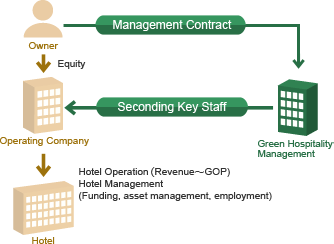
Management contracts were developed since the 1950s. As the large hotel operators, including Hyatt, Hilton, InterContinental and Sheraton, expanded internationally, the owners attempted to optimize the operational efficiency by employing the services of professional operators outside to manage the hotel's operation.
[Source: http://www.ghm.co.jp/en/ownner/ourservice/]
Since then, hotel management contracts have become a fixture in the hotel industry for most full-service, upscale, luxury, resort, and convention properties. It is estimated that there are 800 management companies managing 12,000 properties worldwide. About 4,370 of them were managed by the 9 largest hotel companies.

Marriott International is one of the world’s largest hotel management companies from America, managing and franchising a broad portfolio of hotel chains and related lodging facilities. Examples of subsidiary hotel brands under its management includes JW Marriott, Sheraton, W Hotels and more.
[Source: http://www.marriott.com/]

Hyatt Hotels Corporation is an American multinational diversified hospitality company. The company’s business scope includes hotel owing, hotel brand developing, hotel management and franchise. It manages hundreds of hotels around the world, with over 140,000 rooms owned and managed.
[Source: https://about.hyatt.com/]

Four Seasons Hotels and Resorts is a Canadian international hospitality company. Four Seasons Hotels is quite different from other hotel companies that it does not own its properties, except for the Four Seasons Hotels Vancouver. Instead, it signs contracts with the property owner to receive the permission to participate in the property’s design and run it with almost 100% control over every aspect of the operation.
[Source: https://www.fourseasons.com/]

Mandarin Oriental Hotel Group is an international hotel investment and management group with luxury hotels, resorts and residences. The hotels under its management contract pervade Asian Pacific, North America, Europe, the Middle East and North Africa. Recently, the company have signed a management contract for a new luxury hotel to be developed in Melbourne, Australia. Expected to be open in 2023, this project is the company’s first property in Oceania.
[Source: https://www.mandarinoriental.com/about-us/]

Langham Hotels International is a wholly owned company of Great Eagle Hospitality Group, which is one of the Hong Kong's leading property companies. Apart from overseeing the operations and performance of its own hotels, the company also provides professional management services to its developer-partners and owner-partners. Throughout years, the company has obtained numerous new management contracts, the collaborative hotels include Langham Place Samui at Lamai Beach, Langham Place Beijing Capital Airport Hotel in Beijing, Langham Place in Phayathai Bangkok.
[Source: http://www.langhamhospitalitygroup.com/]
3. Vacation Ownership

Vacation ownership is a form of shared property ownership, commonly in vacation or recreation condominium property, in which rights rest in several owners to use property for a specified period each year.
[Source: https://www.slideshare.net/wynasia/introducing-vacation-ownership]

In 1965, The first hotel-condominium vacation ownership appeared on the island of Maui, Hawaii, namely Hilton Hale Kaanapali. After several years of improvement, vacation ownership became more and more common. Resorts all over the world were trying to convert to this model, with a broader customer base consisted of people from all economics and backgrounds. By 1990’s, primary hotel companies including Hilton, Marriott and Hyatt started to offer vacation ownership properties. Customer acceptance and timeshare sales were recorded high.
[Source: http://www.ebay.co.uk/itm/1951-maui-hilton-hotel-pool-kaanapali-hi-maui-co-postcard-hawaii-/190741577942]

Today, vacation ownership is widely accepted by people all over the world, gaining nearly 5,000,000 owners worldwide. According to a recent survey conducted by the Canadian Vacation Ownership Association, 85.6% of the respondents are satisfied with their vacation ownership, showing a favourable environment for the business to grow continuously.
[Source: https://www.insidethegate.com/2017/03/canadian-vacation-ownership-association-cvoa-continues-to-grow/]

Hilton Grand Vacation has more than 4,300 affiliated resorts in more than 100 countries and territories. They located in various locations, including New York City, Orlando, Miami Beach, Carlsbad, CA, Florida Gulf beaches, the Las Vegas Strip and Hawaiian Islands
[Source: http://www.hiltongrandvacations.com/]

Wyndham Worldwide operates a total of 219 vacation ownership globally. Some of its businesses locate in the United States, Canada, Mexico, the Caribbean, South America and the South Pacific, etc.
[Source: http://fortune.com/fortune500/wyndham-worldwide/]

Marriott Vacation Club operates over hundreds of the affiliated timeshare resorts incountries, such as Australia, Las Vegas, Hawaii, Myrtle Beach, Orlando, Lake Tahoe, Spain and Thailand.
[Source: http://www.marriottvacationclub.com/]
Learning Reflection
Nowadays, hotels actively expand their business through vacation ownership, franchising and management contracts. After the research, I found that some of the largest hotel companies, such as Marriott International and Wyndham Hotel Group, have actually participated in all three types of hotel business. This reflects how these types of expansion can help the hotel companies be competitive in the industry. Besides, vacation ownership has become more and more popular recently, which hotels could put more focus on, in order to capture greater profits.
Reference
[1] Marriott Vacation Club. Retrieved from http://www.marriottvacationclub.com/
[2] Wyndham Worldwide. Retrieved from http://www.wyndhamworldwide.com/category/wyndham-vacation-ownership
[3] Hilton Grand Vacation. Retrieved from http://www.hiltongrandvacations.com/
[4] Marriot International Franchise Cost & Fees. Franchise Direct. Retrieved from https://www.franchisedirect.com/travelfranchises/marriott-international-franchise-08393/ufoc/
[5] Wyndham Hotels and Resorts Franchise Cost & Fees. Franchise Direct. Retrieved from https://www.franchisedirect.com/travelfranchises/wyndham-hotels-and-resorts-franchise-08394/ufoc/
[6] Hilton Hotels & Resorts Franchise Cost & Fees. Franchise Direct. Retrieved from https://www.franchisedirect.com/travelfranchises/hilton-hotels-resorts-franchise-08360/ufoc/
[7] Mandarin Oriental to open Melbourne hotel. 19 Jul 2017. CEI. Retrieved from http://www.cei.asia/article/mandarin-oriental-to-open-melbourne-hotel/438206
Comments